
Share
Well, that didn’t take long.
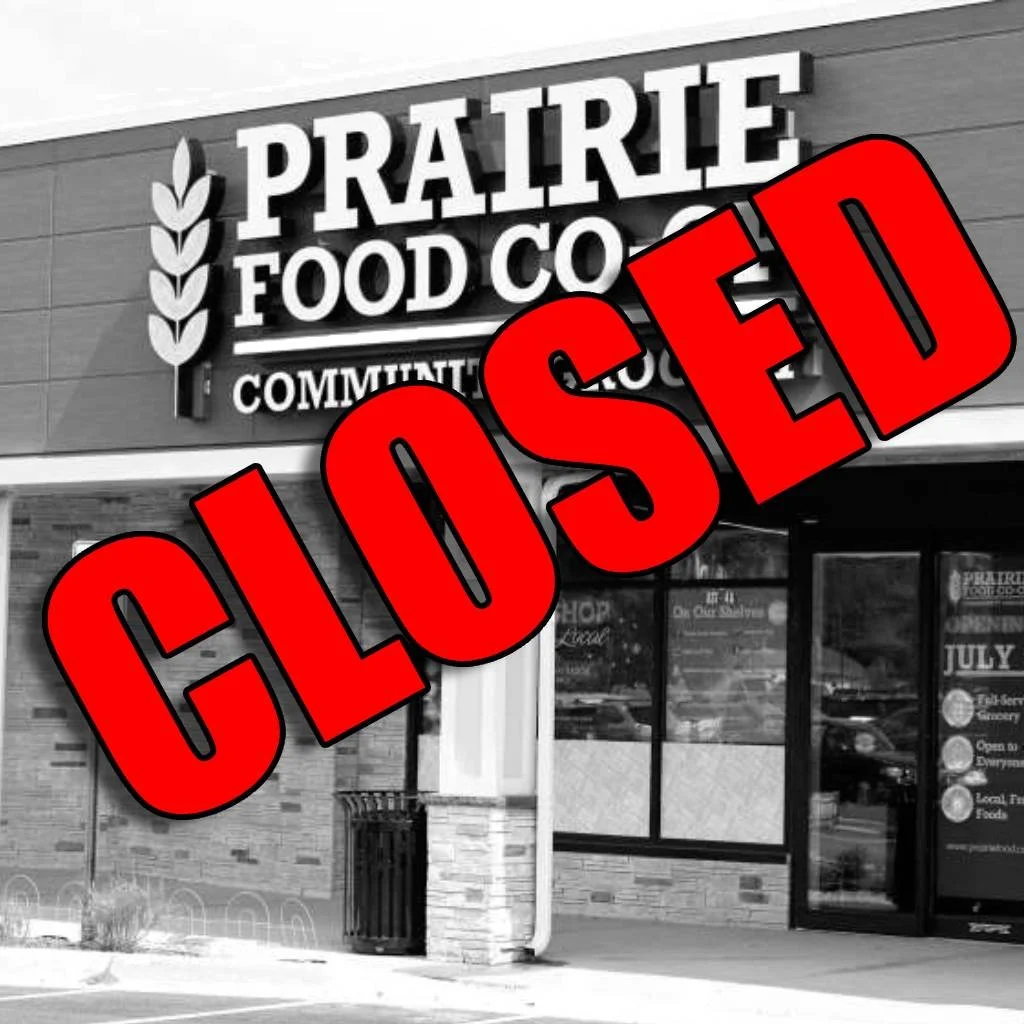
After 13 years of planning, organizing, fundraising, and, I imagine, plenty of conversations about how morally superior they were to the capitalists, the Board of Directors at Lombard's Prairie Food Co-op has announced that the store is closing. It opened in July 2025 and barely made it 16 months before reality set in. 13 years of planning gone in 16 months. Ouch. It turns out that a community-owned grocery store simply can't survive without a community to buy groceries.
According to the Daily Herald, Prairie Food Co-op needed roughly $80,000 in weekly sales to survive. It was bringing in about half of that. The store had approximately 2,700 member-owners who paid $200 apiece for their shares. But, according to a board meeting, roughly 600 had stopped shopping there. People actually paid money to own a piece of this grocery store, then decided they’d rather buy their groceries somewhere else. I can imagine this being the plot of a Seinfeld episode.
Now, I’m all for entrepreneurship. If a group of neighbors wants to put their bread ($$) together, open a grocery store, and sell pickles for $9 a jar, God bless America. That’s their business. Literally. A voluntary co-op isn’t inherently socialism. However, Prairie Food Co-op received approximately $1.56 million in state and federal grants. That’s taxpayer money. Yours. Mine. When everyday citizens have to pay for someone else’s entrepreneurial failures, that is socialism.
And where did this publicly supported experiment in grocery-store utopianism take place?
Lombard, Illinois. The western suburb where median household income is about $108,300 and typical home values hover near $396,000. Are there struggling families in Lombard? Of course, as in many American communities. But in this situation, we’re talking about spending public money to improve food access. I can think of several Illinois suburbs where we (we because my money is being used) could run a co-op experiment before Lombard. How about Harvey, with a median household income of $42,429? Or Chicago Heights at $52,800? Or Robbins at $40,668?
This looks like a liberal vanity project. It’s almost too ridiculous to parody.
Beyond just the grocery store, conservatives have warned for decades about the central flaw in socialist thinking: the belief that good intentions, collective decision-making, and other people’s money can substitute for economic reality. They can’t. The free marketplace is as cold as a walk-in freezer, but it still tells the truth. Compassion in the free market means nothing if the bills aren’t getting paid.
Maybe shoppers liked the concept of the co-op, but not the prices. Maybe they didn’t like the selection. Maybe they preferred Jewel-Osco, Aldi, or Walmart. Whatever their reasons, they voted with their wallets. No matter how hard you try, you cannot guilt-trip people’s wallets.
Socialism’s fundamental weakness is that it makes a god of the collective. We have a duty to do what’s right for the common good. We are obligated to love thy neighbor. But we cannot strong-arm others into funding community experiments they may or may not agree with.
Socialism ignores the millions of shoppers in favor of an oligarchy of political planners. Those planners use government subsidies, i.e., other people’s money, and when the projects fail, they become someone else’s headache. Losses don’t vanish into the ether. They just move to the taxpayers, while the decision-makers pat themselves on the back because they think they did the right thing.
Markets are imperfect, but they give customers the choice to say no. No bureaucratic red tape needed. They simply shop somewhere else. Those decisions are information. Ignore them long enough, and reality sends a reality check. All over the country, public grocery stores close, one after another. They even shut down in rural areas where food deserts are more pronounced. Chicago’s Mayor Brandon Johnson explored a city-run grocery store. After intense pushback, he scrapped the idea.
To the board’s credit, it eventually recognized that another $500,000 wouldn’t necessarily save the business. Better to close than keep throwing money into a hole. Still, there’s a lesson here for every politician convinced that a generous grant and a feel-good slogan can outsmart the marketplace. Businesses survive by serving customers. When customers say no, any decent businessperson should listen.
In the end, the market held an election in Lombard. The ballots were grocery receipts.
Reality and arithmetic won in a landslide.
Written by Vincent Williams
He is a former Music Director at Windy City Underground radio, an on-air talent at Logik Radio and a board operator, sound engineer and videographer. Writing has always been an integral part of Vincent's life. He is a born-again Christian, a lifelong Chicagoland resident, a zodiac Cancer and a lover of anything mint-flavored.
Latest Articles



Explore More Topics

Now, I’m all for entrepreneurship. If a group of neighbors wants to put their bread ($$) together, open a grocery store, and sell pickles for $9 a jar, God bless America. That’s their business. Literally. A voluntary co-op isn’t inherently socialism. However, Prairie Food Co-op received approximately $1.56 million in state and federal grants. That’s taxpayer money. Yours. Mine. When everyday citizens have to pay for someone else’s entrepreneurial failures, that is socialism.