
Share
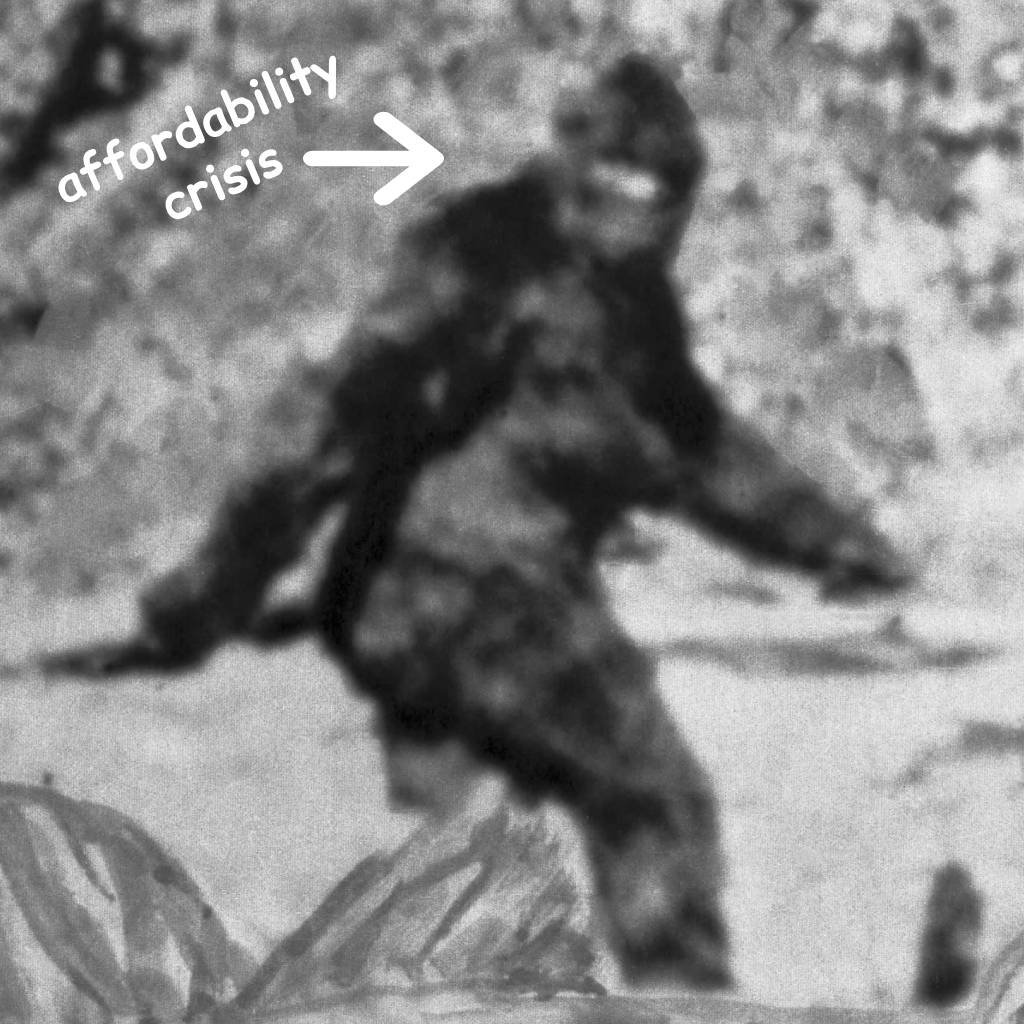
Every few years, someone claims to have seen Bigfoot. Someone from rural Washington shows a grainy photo—in an age of amazing smartphone cameras. Joe Schmoe from Timbuktu swears he saw it in the woods. It was big, hairy, and scary. Earlier this year, people swear they saw Bigfoot in northeast Ohio. According to the Bigfoot Society podcast (because, of course, why wouldn’t there be a Bigfoot podcast?), the same area reported a wave of Bigfoot sightings in the 1970s.
The stories keep coming. The evidence, not so much.
That’s the affordability crisis: Bigfoot. Politicians swear it’s real. Pundits warn that it’s lurking around every corner. There’s an entire cottage industry of economists who swear they’ve seen it. But when you ask for tangible evidence of a nationwide economic catastrophe, the picture gets as blurry as the Bigfoot photos.
Kevin Hassett, director of the National Economic Council, made the liberal media’s heads explode when he said last week, “Affordability crisis is a myth.”
Kevin Hassett: "The affordability crisis is a myth" https://t.co/BjfxCHmKKl
— Aaron Rupar (@atrupar) October 26, 2026
He’s right, and the data backs him up: the affordability crisis is a myth.
On Tuesday, October 27, the Conference Board reported that its U.S. Consumer Confidence Index rose 7.5 points to 91.7 for the month. It's the first increase in four months. The less-discussed Present Situation Index, which measures Americans' assessments of current business and labor market conditions, climbed 8.6 points to 120.4. Both figures substantially exceeded expectations.
According to the U.S. Census Bureau, real median household income reached a record $87,460 in 2025. The official poverty rate fell to a record-low 10.2 percent. Unemployment stood at 4.2 percent in September 2026. Taken together, these figures contradict the idea of a nationwide affordability collapse.
Strange numbers for an economy in shambles.
JPMorgan Chase CEO Jamie Dimon made a few more heads explode when he said the U.S. economy is booming.
"Corporations are not overleveraged. Consumers are not leveraged. Unemployment is really low," Dimon said.
"You can argue whether wages are going up enough for the lower end, probably not, but they have jobs. And that is the single sole most important thing for most people: that they have a job and they go to work."
Even Politico, not exactly a right-wing outlet, has to admit the economy is doing well.
Senior reporter Sam Sutton writes: “Nearly three-quarters of Americans believe economic conditions are worsening…and they identify rising living costs as the biggest impediment to their finances.”
In a bad economy, people would slow down their spending, right?
“Americans never stopped spending. They spent when their paychecks weren’t keeping up with prices. They spent when high interest rates eroded their purchasing power. They spent when retailers hit them with tariff costs, and they spent through the longest government shutdown in history.
American paychecks are larger now than before the pandemic, even after five years of elevated inflation. When the Iran war pushed gas prices above $4 per gallon, people kept their wallets open. And when they claimed that rising prices had forced them to pull back, Federal Reserve researchers found they were actually buying more.”
That doesn't mean everyone is prospering. Spending can conceal financial strain. But the spending data should make us skeptical of sweeping claims that American purchasing power has simply evaporated.
In other words, people are spending money like the economy is booming. Maybe because, deep down, they know it is, even if the television is telling them otherwise.
The affordability truthers cannot honestly dispute the numbers. So, their fallback, of course, is gas prices.
And I'll grant them that one. Gas prices are up significantly this year. Filling a tank can be painful, especially for lower-income households. Insurance is expensive. Housing costs in many markets are brutal. A trip to the grocery store and gas station can easily set a family back a couple hundred bucks.
Those are real problems that the Federal government is not entirely responsible for. Local legislation also plays a role in gas and food prices.
But when President Biden launched his proxy war on Russia, and gas prices went up, I don’t recall hearing too much complaining. I remember everyone slapping “I stand with Ukraine” bumper stickers on their cars.
Sutton from Politico continues: “Economists find the word ‘affordability’ almost a nonsensical word,” Betsey Stevenson, a former economic adviser to President Barack Obama and now a professor of public policy at the University of Michigan, told me.
It boils down to the fundamental elements of economics, she added. There are finite resources for meeting everyone’s demands. Everyone’s demands are different, everything comes at a cost, and “people always want more.”
“You can afford anything,” Stevenson said. “The question is just: What do you have to give up to get it?”
Let’s put aside all the data and economic jargon for a moment and look at the evidence around you. What do your eyes tell you?
I live in a stable, middle-class suburb. I went to Menards the other day. The parking lot was filled with huge vehicles: Hummers, Broncos, Ford F-150s, Toyota Tundras, Escalades. If the economy is bad and gas is burning holes in people’s pockets, you would think people would downsize their vehicles. Everywhere I go, I’m noticing larger and larger vehicles. I passed by Dunkin’ on the way to church. The line of cars wrapped around the building. Same thing at Chick-fil-A and Portillo's (a popular Chicago-based hot dog spot).
More homes in my neighborhood seem to have Halloween decor outside—large blow-up skeletons, black cats, spiders, Frankensteins, etc. Halloween decorations ain’t cheap, and that’s another sign people are still spending.
Now, I'm not pretending that a Menards parking lot constitutes a national economic survey. My suburb isn't the whole country. Some of those trucks are probably financed, and some of those decorations have probably been sitting in garages for years.
But the spending is too widespread to ignore.
So why all the talk about an affordability crisis?
Look at the calendar. It’s election season. Democrats are campaigning on the idea that the economy is crushing Americans, and their allies in much of the news media have every incentive to amplify that message. Misery makes compelling television, and economic frustration makes useful political ammunition.
Democrats have gone all in on transgenderism, abortion, racism, and antisemitism. They are all losing issues. Creating myths about the economy is all they have left.
If the claim were simply that certain necessities have become painfully expensive, I'd agree. If the claim were that housing affordability deserves serious attention, I'd agree with that, too.
But that's not the claim. The claim is that the whole thing is broken, that the middle class is being crushed, that we're in a crisis — and that's why you must vote Democrat on November 3.
A crisis is 2008. A crisis is 2020. Mass unemployment, collapsing demand, shuttered businesses, and genuine economic paralysis.
We have the opposite. Unemployment is low, real consumption is up a trillion bucks, capital is flooding in, consumer confidence is rebounding, and poverty is at an all-time low. The only people calling this a crisis are the ones who need it to be one.
Not every American can effortlessly afford a new car or home or fill their refrigerators and gas tanks. But there is a difference between acknowledging economic hardships and declaring the American economy a disaster.
For decades, Bigfoot hunters have produced everything from eyewitness accounts to large footprints to grainy photos. Yet, we have never seen Bigfoot in crystal-clear HD.
Likewise, the liberal pundit class keeps telling us to believe the television and not our eyes.
The footprints are real. The monster is a campaign prop.
Written by Vincent Williams
He is a former Music Director at Windy City Underground radio, an on-air talent at Logik Radio and a board operator, sound engineer and videographer. Writing has always been an integral part of Vincent's life. He is a born-again Christian, a lifelong Chicagoland resident, a zodiac Cancer and a lover of anything mint-flavored.
Latest Articles


Explore More Topics
There is another institution that is entrusted with America’s children. One that exercises enormous authority over their day-to-day lives, shapes their understanding of the world, and demands the confidence of their parents.
The American public school system.
Do we have millstones for them?