
Share
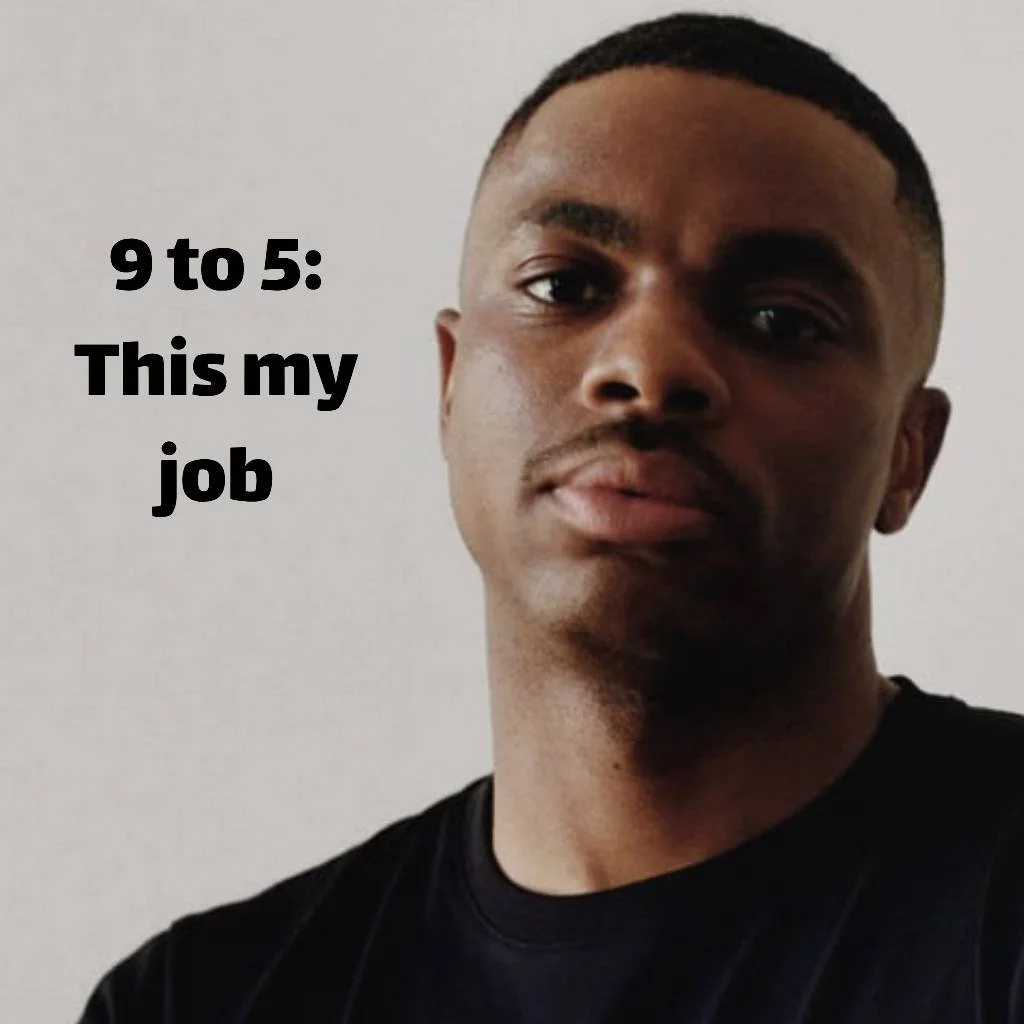
Vince Staples was asked to name his favorite Vince Staples song. His answer was wonderfully unsentimental.
“I don't know, man. One of 'em. Whatever one got the most streams." The interviewer asked an appropriate follow-up: “You don’t have a favorite? You, personally?”
The 33-year-old Compton, California rapper replied, “This my job. They don’t got a favourite burger when they flip them at McDonald's.”
Vince Staples on why he doesn’t have a favourite song he has made:
— Dobson 🦋 (@ByDobson) September 8, 2026
“This my job. They don’t got a favourite burger when they flip them at McDonalds” pic.twitter.com/oPrQowftJF
That irritated some people.
He made those comments last month at All Points East, an urban music festival in London. But his answer and subsequent online back-and-forth with fans are still drawing headlines.
But the reaction says more about our culture than Vince Staples.
There’s this weird expectation these days that if you are fortunate to make money doing something creative, you have to speak about it like it is a sacred heirloom. The writer can’t simply write. The painter can’t simply paint. The musician cannot simply make music. You apparently have to speak about it like it is a piece of your soul.
For some people, it is. For others, it’s just something they happen to be good at.
Vince Staples has a healthier view of work than many of the people criticizing him.
We all know that work matters. Christians, of all people, should understand that better than most. But work is not to be idolized or deified, a sin modern culture commits regularly.
Kids are told to “follow their dreams” and “pursue their passions.” College professors tell their students that their careers should make them feel fulfilled. Adults convince themselves that working a regular nine-to-five job means they must have taken a wrong turn in life. Maybe they got off on the wrong exit and ended up on Blue Collar Boulevard.
Sometimes, work feels like work. Sometimes you have to get out of bed when you don’t want to, do something you wouldn’t do for free, get paid, and go home. There’s a quiet dignity in that. Scripture says, “And whatever you do, do it heartily, as to the Lord and not to men” (Colossians 3:23).
A little faith and perspective go a long way here.
Think about a carpenter. He doesn’t need to get tingles up his spine every time he installs a new cabinet. A plumber does not need to have a passion for unclogging drains. The mechanic at Jiffy Lube probably doesn’t have a burning desire to change your oil. They do the job because the job needs to be done. There’s nothing wrong with that. That should count for something.
We like to think that all athletes are passionate about what they do. You’d be amazed how many of them treat sports like it’s just a job. They hit the genetics lottery. They are good at shooting a basketball or throwing a baseball. And can make a whole bunch of money doing it. But they are not passionate about it. The fans, many times, are more passionate about the sport than the players are.
Furthermore, here’s where Vince Staples’ McDonald’s analogy gets more interesting. Why are people offended by comparing a rapper to someone working in fast food? Staples wasn't insulting the McDonald's employee. His critics were revealing how low they consider the McDonald's employee.
We have accepted the premise that what a celebrity does is more important than what a typical American does. Sure, people pay thousands of dollars to watch Kanye get on stage in a ski mask and rap a bunch of songs. But the mechanic who changed the oil on a car so a guy can go to work and provide for his family, the man plowing the roads in the winter so people can get from point A to point B safely, the police officer keeping the neighborhood safe are far more important than Kanye could ever be.
Musicians are considered “artists.” Actors are “creatives.” Celebrities have “crafts.” Meanwhile, we regular Joe Schmoes have “jobs.”
And how a society thinks about work matters because that thinking eventually determines which people we believe matter.
If we teach people that the only worthwhile work is exciting work, prestigious work, creative work, or work that comes with a blue checkmark and an Instagram following, we should not be surprised when ordinary jobs are treated as consolation prizes. Somebody still has to collect the garbage. Somebody still has to fix the transmission. Somebody still has to stock the grocery-store shelves at six in the morning. Somebody has to pour the concrete, drive the truck, clean the office, answer the phones, and keep the lights on.
A healthy society honors those people because it understands that civilization is held together by millions of ordinary people doing ordinary things reliably. Most of the work that makes your life possible will never win a Grammy. Nobody is going to make a documentary about the men who made sure the sewage system worked today. But you would notice if the sewage system stopped working.
That is why turning work into a vehicle for self-expression can become so destructive. The question slowly changes from “What needs to be done?” to “Does this make me feel fulfilled?" A culture obsessed with the latter eventually produces people who think necessary work is beneath them simply because it is boring, dirty, repetitive, or unimpressive.
Our work should not be the foundation of our identity.
Sure, art can be personal. “Pour your soul,” as they say. Vince Staples often refers to his childhood, his observations about life, and his surroundings in his music. His latest album, Cry Baby, is not exactly 35 minutes of jingles about car insurance.
Our culture cannot separate the idea of work being part of your identity from being the foundation of your identity. We see this from the feminists. Women forgo having children during their peak physical years so they can climb the corporate ladder.
The unsettling reality of work is that we are more temporary than the work. When we age out and retire, the job will still be there, in some form. Which is why having a foundation in Christ is paramount.
If your job is who you are, what happens when you lose it? Would you have the resolve to find a new job, or would you ball up in the fetal position and hold a grudge against your former employer?
If your career is your purpose, what happens when you retire? That’s why so many athletes crash out when their playing days are done.
If your artistry is an extension of your soul, what happens when people hate the new album?
Obviously, Vince Staples understands this, which is why he seems so impervious to criticism. Someone calls him the Walmart version of Kendrick Lamar (me; I called him that), oh well. Someone doesn’t like his latest album, Cry Baby (me; I didn’t like the album), oh well.
Rapping is just a job to him. There are more important things in life.
Work deserves respect because people deserve respect. But that is precisely why work has to remain in its proper place. We should neither despise ordinary labor nor worship extraordinary careers. Both errors come from assigning work a spiritual weight it was never meant to carry.
Jobs are great sources of income, but they make terrible gods.
Written by Vincent Williams
He is a former Music Director at Windy City Underground radio, an on-air talent at Logik Radio and a board operator, sound engineer and videographer. Writing has always been an integral part of Vincent's life. He is a born-again Christian, a lifelong Chicagoland resident, a zodiac Cancer and a lover of anything mint-flavored.
Latest Articles




Explore More Topics
There’s this weird expectation these days that if you are fortunate to make money doing something creative, you have to speak about it like it is a sacred heirloom. The writer can’t simply write. The painter can’t simply paint. The musician cannot simply make music. You apparently have to speak about it like it is a piece of your soul.
For some people, it is. For others, it’s just something they happen to be good at.
Vince Staples has a healthier view of work than many of the people criticizing him.